Home › Geophysical services › EMI and RFI site surveys
11 / Interference
EMI and RFI site surveys
An electron microscope that will not resolve, an MRI with artefacts, a balance that will not settle. The cause is often outside the building and was measurable before anybody broke ground.
The problem is that it is discovered late
A research building, an imaging suite or a metrology lab is specified around instruments that are extraordinarily sensitive to magnetic and radio-frequency fields. Thresholds run down to fractions of a milligauss for high-performance electron imaging, and to a volt per metre for scientific and medical equipment across the radio spectrum.
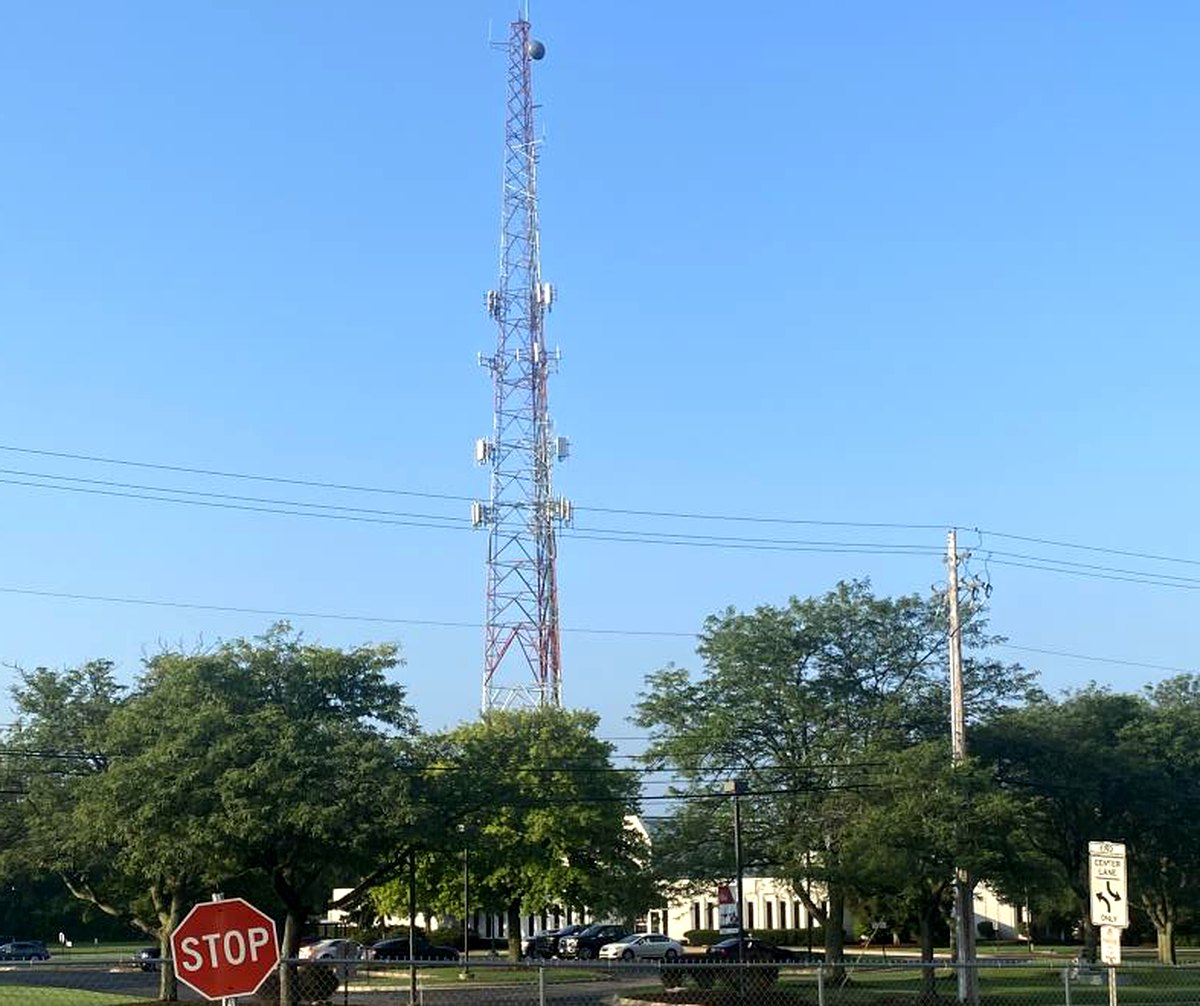
Those thresholds are routinely exceeded by things nobody thinks of as a hazard: a transmission line four hundred feet away, a cell mast on a neighbouring property, traffic on an adjacent road, a passenger elevator two rooms over, the building's own switchgear.
Discovered during commissioning, the remedies are shielding, active compensation, or moving the instrument — and all three are expensive at that point. Measured before the footprint is fixed, most of them are solved by a decision that costs nothing: put the building there instead of here, and put the imaging suite on that side of it.
What we measure
- AC ELF magnetic flux density — 60 Hz and its harmonics, the field that couples into conductors and makes an image jitter. Mapped across the footprint with a three-axis gaussmeter and survey wheel at one metre above grade, recorded at one-foot intervals and presented as profile and contour plots rather than a handful of spot readings.
- Quasi-static DC magnetic fields — the perturbations of the earth's field caused by large ferromagnetic masses in motion. Vehicles on a nearby road, a lift, a rolling steel door. Recorded as timed differential data with a fluxgate magnetometer, because what matters is the peak-to-peak change over time, not a static value.
- RF electric field strength — swept across the spectrum from 100 kHz to 3 GHz with an isotropic spectrum analyser, assessed against the 1 V/m threshold used for scientific and medical instruments and the 3 V/m industrial level.
Measurement is the easy half
A number on its own does not tell an architect where to put a room. The work is turning the field data into separation distances and design decisions.
Because the decay behaviour of each source type is known or can be characterised, a measured field can be projected: how far from that road does the DC perturbation fall below the threshold for a transmission electron microscope; how far from a passenger elevator of known car and counterweight mass; how far from the switchgear room. Those distances are what the layout is actually drawn around.
Where separation alone will not do it, the alternatives are magnetic shielding, active compensation systems, or changes to the electrical design — and the electrical design is usually where the real risk sits. Circulating ground currents from a single wiring fault will travel the building steel and produce fields in an imaging suite that no amount of site selection would have avoided. We specify the practices that prevent it: dedicated neutrals per phase, neutral isolation testing documented during construction, routing rules for feeders and busways, and where it is warranted, non-ferrous reinforcement in the slabs beneath sensitive tools.
What it will not tell you
A site survey characterises the environment that exists on the days it is measured. It does not bind the neighbours. A mast added later, a substation upgraded, a new tenant with a large drive system — those are outside the record, and a report should be read as a design basis rather than a warranty.
Nor does the survey certify an instrument. Manufacturers set susceptibility criteria for their own tools, and those criteria vary widely and are not always easy to obtain. We measure the site and state the thresholds commonly applied; confirming a specific instrument against a specific manufacturer's figure is a conversation that has to include the manufacturer.
Where it fits
Nanotechnology and materials research buildings, electron and ion beam imaging suites, NMR and MRI installations, calibration and metrology laboratories, cleanrooms, hospitals and university research facilities — and the site selection stage of any of them, which is where this work pays for itself.
On those projects it runs alongside vibration monitoring. Interference and ground motion are the two environmental conditions that decide whether a site can host sensitive instruments, they are measured by completely different physics, and a site that passes one can fail the other.
Equipment and capability
- Three-axis 60 Hz gaussmeter with survey wheel, mapped at one-foot intervals
- Fluxgate magnetometer for timed quasi-static DC data
- Isotropic spectrum analyser, 100 kHz to 3 GHz
- Profile and contour plots across the proposed footprint
- Predicted emission profiles for vehicles, elevators and plant
- Separation distances against instrument thresholds
- Shielding, active compensation and electrical design recommendations
What you receive
Mapped field levels across the footprint with the recording conditions stated, assessed against the thresholds for the instruments the building is being designed around; separation distances per source; and the construction and electrical practices required to hold those levels once the building exists. Written for the design team, because they are the people who have to act on it.
Ask before you commission
Tell us the target, the ground and the constraint and we will say whether this method answers it, whether it needs a second method alongside, or whether something else entirely is the better route. That conversation is free and it is usually short.